

Hantavirus 2026 Explained: What Air Travelers Need to Know Before Flying
Current Situation: Does the Hantavirus Outbreak Affect Air Travel?
A hantavirus outbreak associated with the expedition cruise ship MV Hondius has resulted in 13 reported cases (11 confirmed and 2 probable) including three fatalities. Spain confirmed a second positive case on May 25 among quarantined passengers in Madrid, while the Netherlands reported a new case involving a crew member on May 22.
The World Health Organization (WHO) confirmed the total case count on May 27 and released its fourth Disease Outbreak News report on May 28. Since then, no additional cases have been reported. The WHO continues to classify the global public health risk as low.
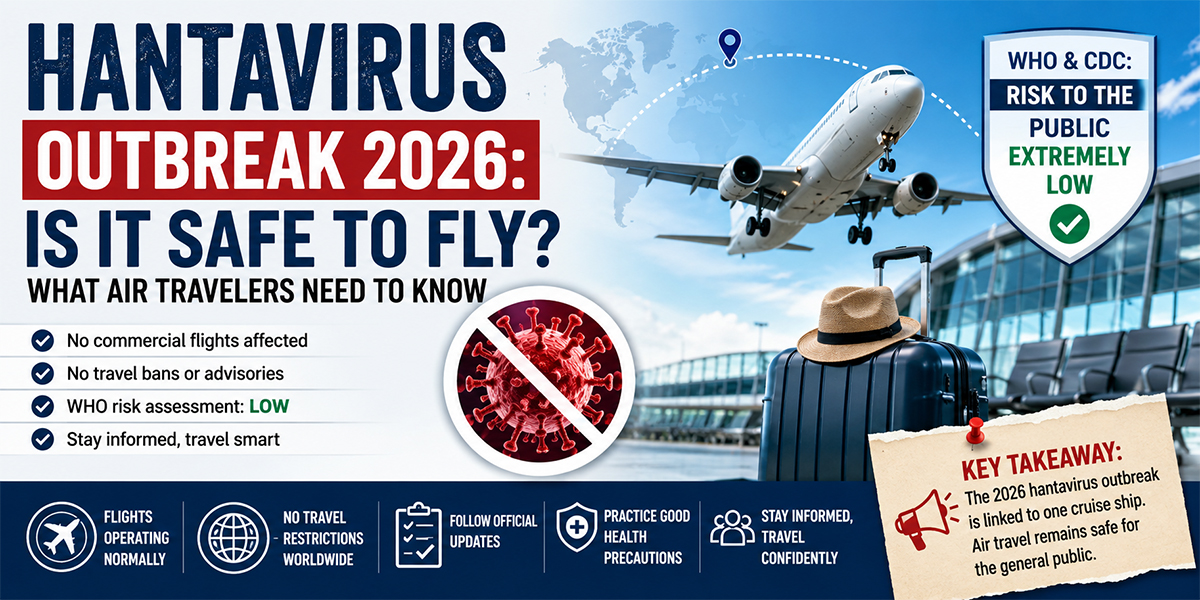
For air travelers, the key takeaway is simple: commercial aviation remains unaffected. No airlines have suspended routes, no airspace restrictions have been introduced and no country has issued travel advisories linked to this outbreak.
No Impact on Commercial Flights
According to WHO guidance, there is currently no reason for travel restrictions or public alarm.
What Has Not Changed?
- No commercial flights have been canceled because of hantavirus.
- No airlines have modified schedules or routes.
- No airports have introduced special screening procedures.
- No countries have implemented travel bans related to the outbreak.
The only flights connected to the situation have been government-organized repatriation flights transporting MV Hondius passengers to quarantine facilities in their home countries. These operations have no impact on regular airline passengers.
Is This Another COVID-19 Situation?
Health authorities have been clear: No.
WHO Director-General Tedros Adhanom Ghebreyesus stated on May 14 that there is no evidence suggesting the beginning of a larger outbreak. While additional cases could emerge because the virus has an incubation period of up to 42 days, experts stress that the outbreak does not resemble a pandemic scenario.
WHO infectious disease specialist Maria Van Kerkhove emphasized that hantavirus behaves very differently from COVID-19 or influenza and does not spread easily through communities.
Public health assessments indicate that transmission remains limited and controlled, with outbreak trends showing a decline rather than expansion.
Why Hantavirus Is Not Considered a Pandemic Threat
The outbreak involves the Andes virus, a rare hantavirus strain capable of human-to-human transmission.
However, transmission generally requires:
- Prolonged close contact with an infected person
- Exposure to bodily fluids
- Extended time spent in enclosed environments
Even among passengers sharing cabins aboard MV Hondius, transmission was not universal.
Unlike COVID-19, which could spread rapidly through casual contact, the Andes virus has demonstrated much lower transmissibility.
The WHO notes that although transmission through respiratory particles may occur under specific circumstances, it does not exhibit the characteristics of highly contagious airborne diseases such as measles or SARS-CoV-2.
Understanding Hantavirus
Hantaviruses are primarily rodent-borne viruses.
People typically become infected through exposure to:
- Rodent urine
- Rodent droppings
- Rodent saliva
- Contaminated dust particles
Most hantavirus strains cannot spread between people. The Andes virus remains the only known exception, and even then, transmission requires close and prolonged exposure.
Because of this, routine air travel does not present a meaningful risk.
Symptoms Travelers Should Know
According to the Centers for Disease Control and Prevention, symptoms usually appear between one and eight weeks after exposure.
Early Symptoms
- Fever
- Fatigue
- Muscle aches
- Headaches
Advanced Symptoms
- Persistent coughing
- Shortness of breath
- Chest tightness
- Respiratory distress
There is currently no approved vaccine or specific antiviral treatment.
Researchers at University of Bath have developed a promising vaccine candidate that has shown strong results in animal studies. Meanwhile, Moderna is exploring mRNA-based vaccine technology in partnership with Korea University College of Medicine. However, any publicly available vaccine remains several years away.
Treatment currently focuses on supportive medical care and intensive respiratory support for severe cases.
The KLM Flight Incident Explained
One aviation-related event attracted significant media attention.
On April 25, a passenger associated with the MV Hondius outbreak boarded KLM Royal Dutch Airlines flight KL592 from Johannesburg to Amsterdam. She was removed from the aircraft before departure due to her medical condition after spending approximately 45 minutes onboard.
Health officials subsequently monitored:
- Five individuals who directly assisted the passenger
- Approximately 50 nearby passengers seated within two rows
Additional contact-tracing operations took place in Italy and France involving repatriation flights linked to known cases.
Importantly, these incidents involved identified outbreak-related passengers and do not indicate a broader risk to commercial aviation.
No evidence suggests transmission among ordinary airline travelers.
What This Means for Travelers
For the average passenger:
- Flights are operating normally.
- Airports remain open without special restrictions.
- No destination has introduced travel limitations because of hantavirus.
- Airlines have not issued schedule changes related to the outbreak.
Industry groups representing flight attendants and airline personnel continue to support standard operations.
Global Repatriation and Quarantine Measures
The MV Hondius departed Ushuaia on April 1 carrying 114 passengers and 61 crew members from 23 countries.
Since the outbreak was identified:
- All passengers have been repatriated.
- More than 600 contacts across 32 countries have been identified and monitored.
- Quarantine and testing programs have been implemented by national health authorities.
The vessel later docked in Rotterdam, where remaining crew members entered quarantine under medical supervision.
When Will MV Hondius Resume Operations?
Operator Oceanwide Expeditions has confirmed that MV Hondius will return to service on June 13, 2026, departing from Longyearbyen.
The May 29 and June 5 sailings were canceled to allow extensive cleaning and disinfection procedures.
All scheduled voyages from June 13 onward are currently expected to proceed as planned.
Travel Advice: What Should You Do?
1. Follow Official Information Sources
Before making travel decisions, check:
- WHO Disease Outbreak News updates
- Your government's travel advisory website
- Your airline's travel alerts page
At present, none recommend altering travel plans because of hantavirus.
2. Review Your Travel Insurance
Travel insurance can provide protection if health emergencies affect your destination.
Consider policies that include:
- Trip interruption coverage
- Emergency medical treatment
- Medical evacuation benefits
- Cancel For Any Reason (CFAR) options
This is especially important for cruise vacations and remote destinations.
Frequently Asked Questions
Can I catch hantavirus on a plane?
The risk is considered extremely low. Hantavirus is primarily spread through contact with infected rodents or contaminated materials. Human transmission of the Andes virus requires prolonged close contact and is not associated with routine airline travel.
Is hantavirus the next COVID-19?
No. Global health authorities agree that this outbreak does not display the transmission patterns associated with COVID-19. Current assessments indicate a limited and declining outbreak.
Have airlines changed schedules because of the outbreak?
No. Airlines worldwide continue operating normally, with no route cancellations or flight restrictions related to hantavirus.
Is there a vaccine available?
Not currently. Vaccine candidates are under development, but none have completed the approval process.
Should I cancel my trip?
No. WHO and national public health agencies continue to support normal travel. There are currently no travel advisories, airport restrictions or flight disruptions related to the outbreak.
Is MV Hondius sailing again?
Yes. Following disinfection and health clearance procedures, the ship is scheduled to resume operations on June 13, 2026.
Final Verdict
For travelers, the 2026 hantavirus outbreak remains a highly localized health event connected to a single expedition cruise ship. Public health agencies worldwide continue to assess the risk as low, and commercial aviation remains unaffected.
If you have upcoming travel plans, there is currently no evidence suggesting that flights, airports, or tourist destinations face increased risk because of the outbreak. Staying informed through official health sources and maintaining comprehensive travel insurance remain the most practical steps for travelers.
Sources
4. European Centre for Disease Prevention and Control — Andes Hantavirus Outbreak in Cruise Ship
5. RIVM — Current Information about Hantavirus
6. US Centers for Disease Control and Prevention — About Hantavirus
7. CBC News — National Lab Confirms Hantavirus Case for Canadian Cruise Passenger Isolating in B.C.
8. Public Health Agency of Canada — Media Update on Andes Hantavirus Situation
9. WOWT — Hantavirus Update: Nebraska Officials Awaiting CDC Guidance on Passengers’ Release
10. NBC News — Spanish Government Confirms New Case of Hantavirus
11. Nebraska Medicine — Hantavirus Monitoring Updates
12. Nature — There Is No Vaccine for Deadly Hantavirus: What That Means for Future Outbreaks
13. Association of Flight Attendants — What Flight Attendants Need to Know about Hantaviruses
14. Oceanwide Expeditions — Press Update, May 18, 2026
15. US News — Hantavirus Cases From Cruise Outbreak Rise to 13 Following New Case in Spain, WHO Says
Disclaimer: Govoygo strives to ensure all information presented in this article is accurate and up to date at the time of publication. Travel policies, prices, visa requirements, and conditions can change rapidly. We strongly recommend verifying critical details with official sources before making travel decisions. Govoygo does not accept liability for any inaccuracies, oversights, or changes that may occur after publication.